Research #3
Looking Abroad
Pure Value Ideas · Nov 4, 2026
Why these three
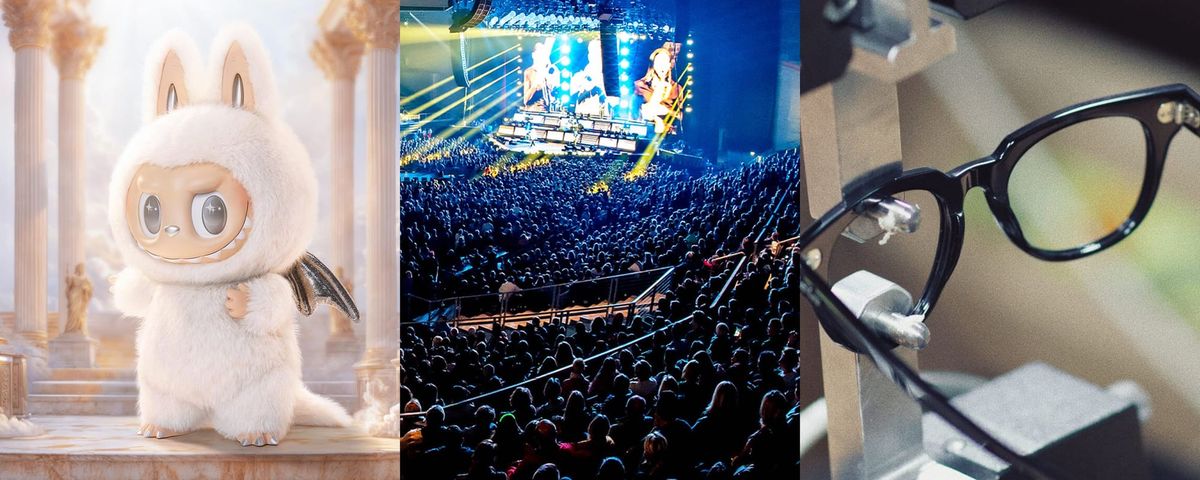
This piece goes to Hong Kong, Frankfurt, and Paris for three companies we spent a lot of time on this year: Pop Mart, CTS Eventim, and EssilorLuxottica.
Two of the three are entertainment businesses. Pop Mart sells collectibles built on characters it owns, plus popular IP it licenses, and Eventim sells access to live events. Both are still run by founders with big personal stakes. Wang Ning owns about 45% of Pop Mart, and Klaus-Peter Schulenberg controls roughly 40% of Eventim through his foundation.
EssilorLuxottica is the only company at almost every step of the glasses supply chain, from the lens all the way to the insurance plan that pays for it, and it's Meta's hardware partner in AI glasses. We were intrigued as the shares fell nearly 60% through September, partly in the luxury sell-off and partly on worries about what AI glasses would do to margins.
As of November 4, Pop Mart hit an 18-month low last week when its third-quarter update showed revenue roughly halved. Eventim is 44% off its May 2025 high and EssilorLuxottica is still 41% below its peak, even after the rebound.
Pop Mart (HKEX: 9992)
Pop Mart has the best owner-operator setup of the three. It owns its characters and its stores, and the founder still runs it. Revenue roughly halved in the third quarter, so the question is how much is a franchise and how much is a fad. We think there could possibly be some lasting franchises under Pop Mart's IP.
The third quarter
On October 27 Pop Mart put out a voluntary, unaudited update for the three months to September. Every region was down.
| Q3 2026 vs Q3 2025 | Revenue change |
|---|---|
| Group | down 45–50% |
| China (company's PRC segment) | down 25–30% |
| China offline (stores and vending) | down 5–10% |
| China online | down 45–50% |
| Asia-Pacific outside China | down 65–70% |
| Americas | down 70–75% |
| Europe and other | down 50–55% |
Most of that is the comp. Third-quarter revenue in 2025 grew roughly 3.5x as Labubu went global, so the business is still well above where it was before the boom:
- The quarter is still up on 2024. Even after halving, third-quarter revenue is roughly 70–90% above the same quarter of 2024 and about double it in China.
- So are most regions. The Americas and Europe are still three to four times their 2024 level, and only Asia-Pacific outside China has slipped back below it.
- The first half was further ahead. Revenue of RMB17.2bn beat all of 2024 (RMB13.0bn) and was nearly four times the first half of 2024.
The shares fell as much as 6% the next morning to an 18-month low of HK$123.80, against a peak of HK$339.80 in August 2025.
The number we care about is China offline. Sales from Pop Mart's own stores and vending machines in China fell only 5–10%, against a year-ago quarter where they'd more than doubled. The collapse was online and overseas, which is where 2025's viral demand ran through marketplaces and resellers. The first half showed the same split, with overseas online revenue down 44% and overseas store revenue up 21%.
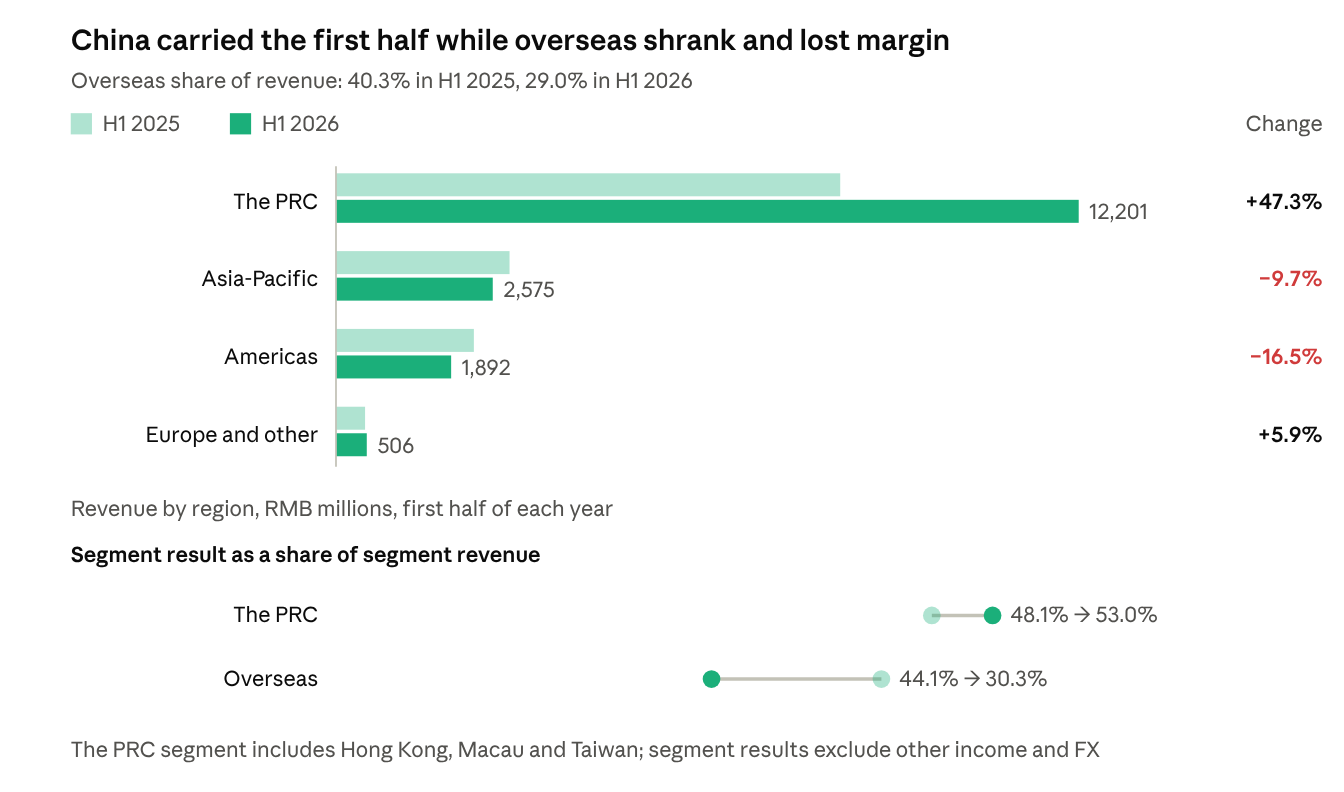
Pop Mart interim results announcement, six months ended June 30, 2026 (HKEX, August 20, 2026): revenue by region and segment results
Management says overseas traffic had leveled off in most markets by the third quarter. It expects every region to grow sequentially in the holiday quarter and China to grow for the full year, and the New York flagships on Fifth Avenue and in Times Square are due to open. None of this caught management off guard. Back in August, Wang Ning said they'd most likely miss the target of at least 20% growth this year and that the second half would be harder than the first.
Product
Pop Mart designs characters with independent artists and owns or controls the IP that comes out of it. It manufactures through its own and partner factories and sells mostly through its own channels, which were 676 stores and 2,827 vending "roboshops" at the end of June. Artist IP, the characters it develops with those artists, made up 89% of first-half revenue, and licensed characters about 10%. We think of it as an entertainment company. A toy company pays royalties and sells through big-box retailers, and it doesn't usually earn net margins near 30% in a slowing half like Pop Mart just did.
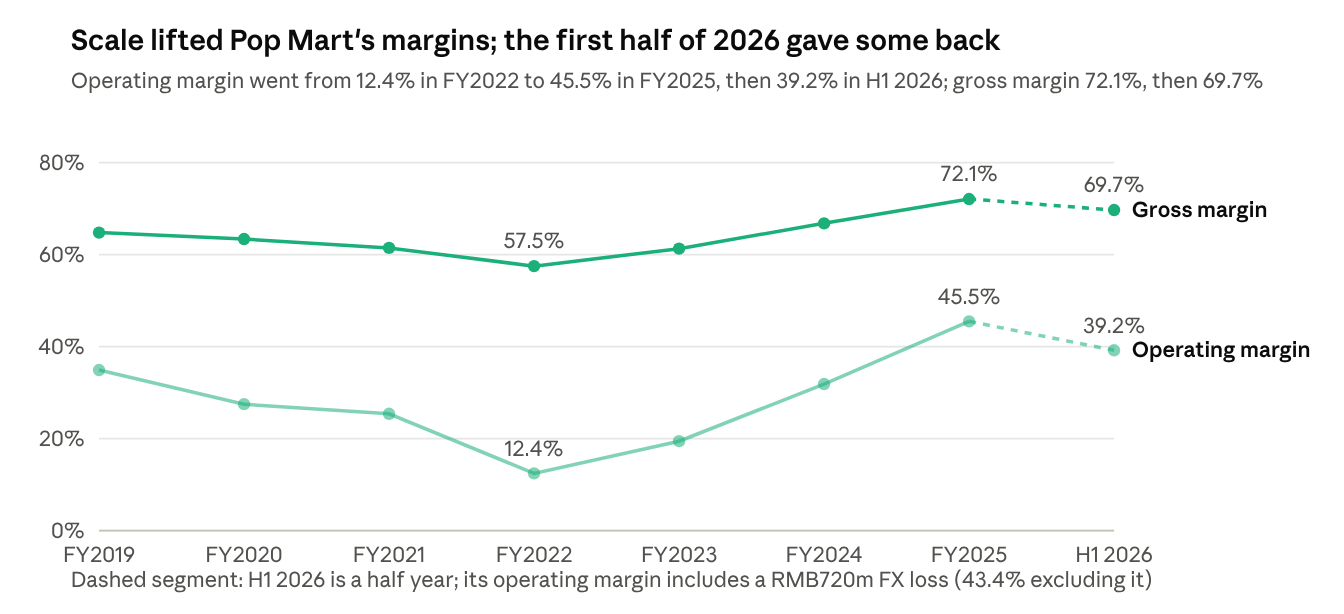
Pop Mart annual results FY2019–FY2025 and interim results H1 2026 (HKEX), compiled in the Pure Value Pop Mart model
Nobody buys a blind box because it's useful, and no software replaces holding or opening a collectible. The risk is that the IP isn't lasting and is only a fad.
So far we don't think the IPs are going anywhere; the business is just less dependent on one character. THE MONSTERS, the Labubu franchise, was 38% of FY2025 revenue and fell 7.5% in the first half even with a World Cup tie-in. MOLLY, the original flagship, fell 34%. The rest of the portfolio is picking up the slack. Twinkle Twinkle grew almost sevenfold to become the second-biggest IP at 15% of revenue, and six IPs each did more than RMB1bn in the half. The mainland membership base is up to 82 million with a 51.6% repeat-purchase rate.
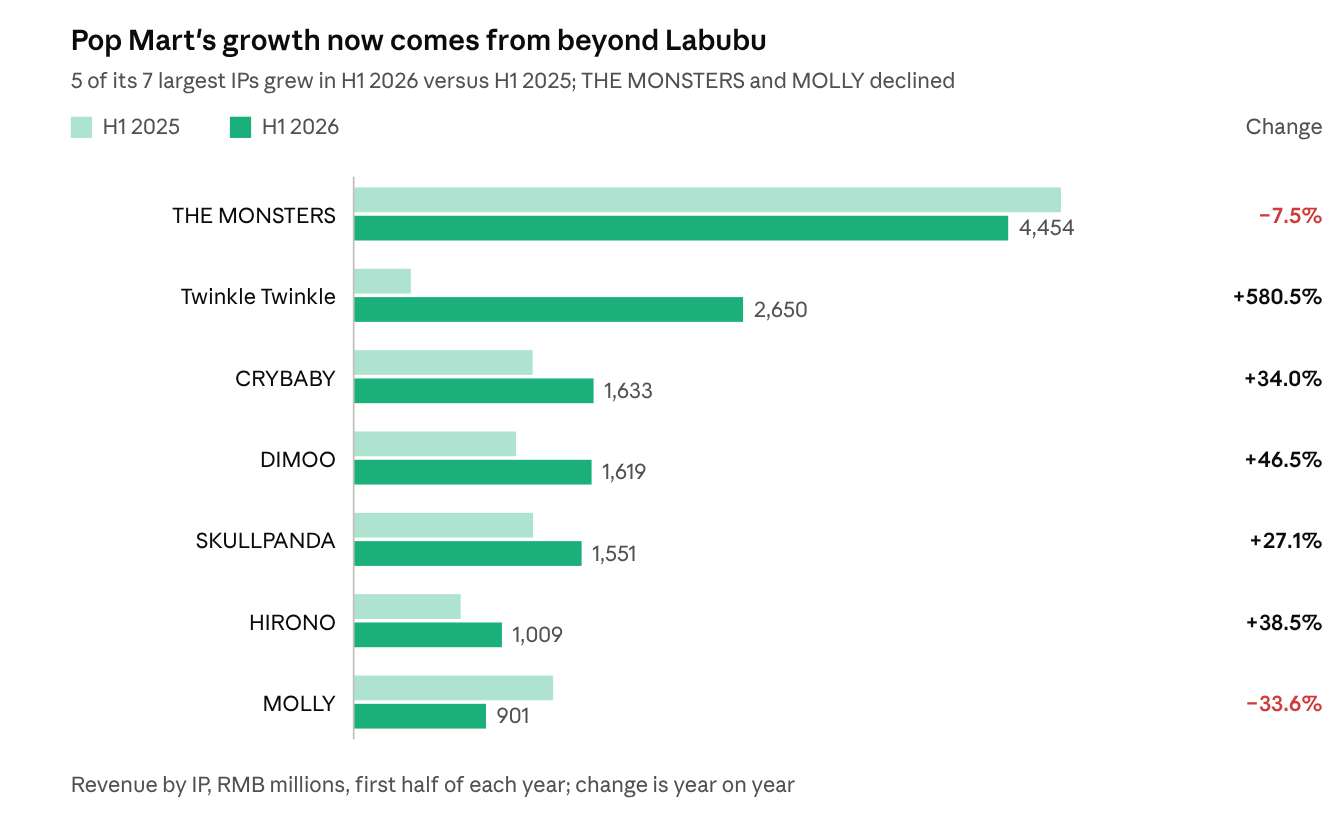
Pop Mart interim results announcement, six months ended June 30, 2026 (HKEX, August 20, 2026), revenue by IP
Why we thought of it as a Chinese Disney
What first drew us to Pop Mart was Wang Ning's ambition. He has pointed to Disney as the model for years. Asked on TV whether he was still benchmarking Disney, he said the two companies are very similar and that Pop Mart is really an IP company. He's also said the original goal of becoming "China's Disney" has grown into building a global Pop Mart. Co-COO Si De told Reuters last year they were borrowing Disney's playbook, using content plus parks and stores so the characters last for decades.
Pop Mart is doing it in roughly the reverse order. Disney started with films and then used parks and merchandise to cash in on characters people already knew. Pop Mart started with the merchandise, which already makes a gross margin near 70%, and is adding the rest now:
- POP LAND in Beijing's Chaoyang Park added zones for THE MONSTERS and DIMOO plus a night tour this year. Management says attendance more than doubled after.
- POP BAKERY opened its first permanent store this year, and Labubu dessert tables are rolling out abroad.
- POPOP sells jewelry and accessories built on the same characters.
- A live-action and CGI Labubu movie with Sony Pictures was announced in March, with Paul King (Paddington, Wonka) directing.
- Flagships in Paris, and soon on Fifth Avenue and in Times Square, work as showcases for the brand.
- IP licensing income more than doubled in the first half, from a small base.
While we don't think it will overtake Disney, we like the approach. Every new format is another way for a character to stay in someone's life once the blind-box novelty wears off. Pop Mart also owns most of its characters, with artists sharing in the profits, so it keeps money that a studio would usually split with licensees.
It's still very early. The reporting line that holds the park and the new formats, together with wholesale, was 4.5% of China revenue in the first half. The film doesn't have a release date. Disney's characters came out of decades of stories, and most of Pop Mart's don't have one. The company has admitted storytelling isn't something it's figured out yet. Wang's argument is that an IP doesn't need a film to last and the park can do that job instead. We're not totally convinced by that, but we're intrigued enough to follow along and see if the right price ever comes.
People
Wang Ning founded Pop Mart in 2010. He's chairman and CEO and owns about 45%. He's been more upfront about the slowdown than most CEOs would be. He called 2026 an "operational adjustment year" and said sales growth isn't the priority. He flagged the likely miss himself, and he's slowed some Labubu releases on purpose instead of chasing volume. That's candor we appreciate from management.
Pop Mart has no bank debt and had about RMB14bn of cash and deposits at the end of June. It bought back and cancelled 11.2 million shares in the first half and paid a RMB3.1bn final dividend. In August it announced a plan to buy back another RMB2–5bn of stock over six months. Stock-based pay is small.
The most interesting outside holder is Duan Yongping, the investor and entrepreneur behind several big Chinese consumer electronics companies. He bought about HK$1.47bn of stock in May at roughly HK$150 a share, taking him to 5.69%, and says he's very unlikely to sell within ten years. He paid more than today's price.
Price
Pop Mart isn't cheap yet. It only looks inexpensive on trailing earnings, and those include the 2025 peak. Our base case, rebuilt after the third quarter, puts the shares at HK$130.51, about 5% below the HK$137.10 close on November 4. We don't know what a normal year looks like for this business, and we won't call it a bargain until we do.
CTS Eventim (XETRA: EVD)
Eventim is Europe's biggest ticketing platform with a concert promoter attached, and ticketing makes most of the money. The company has compounded for twenty years without diluting shareholders, and the founder is still buying stock.
Product
There are two segments and they look nothing alike. Ticketing did €454m of adjusted EBITDA on €977m of revenue in FY2025, a 46.4% margin. Live Entertainment, which is promoting plus venues, did €130m on €2,152m, a 6.1% margin. Ticketing is about a third of segment revenue and close to four-fifths of segment profit.
That's why the 19% group margin undersells the business. Promoting is booked gross, so the full ticket price comes in as revenue and the artist's fee goes out as cost. We think of Eventim as a ticketing company that happens to own promoters, which are there mostly to feed the ticket rail. In FY2025 they ticketed €50m of business through Eventim's own platform.
Revenue went from €256m in FY2005 to €3,079m in FY2025, about 13% a year, while EPS compounded at about 15%. It fell in only three of those twenty years, and one of them was 2020, when live events were banned. The Ticketing margin climbed from about 37% to 46% as sales moved online and volume scaled. There's been almost no dilution along the way. The share count has been 96 million since 2014, and stock-based pay was under €1m last year with no options outstanding.
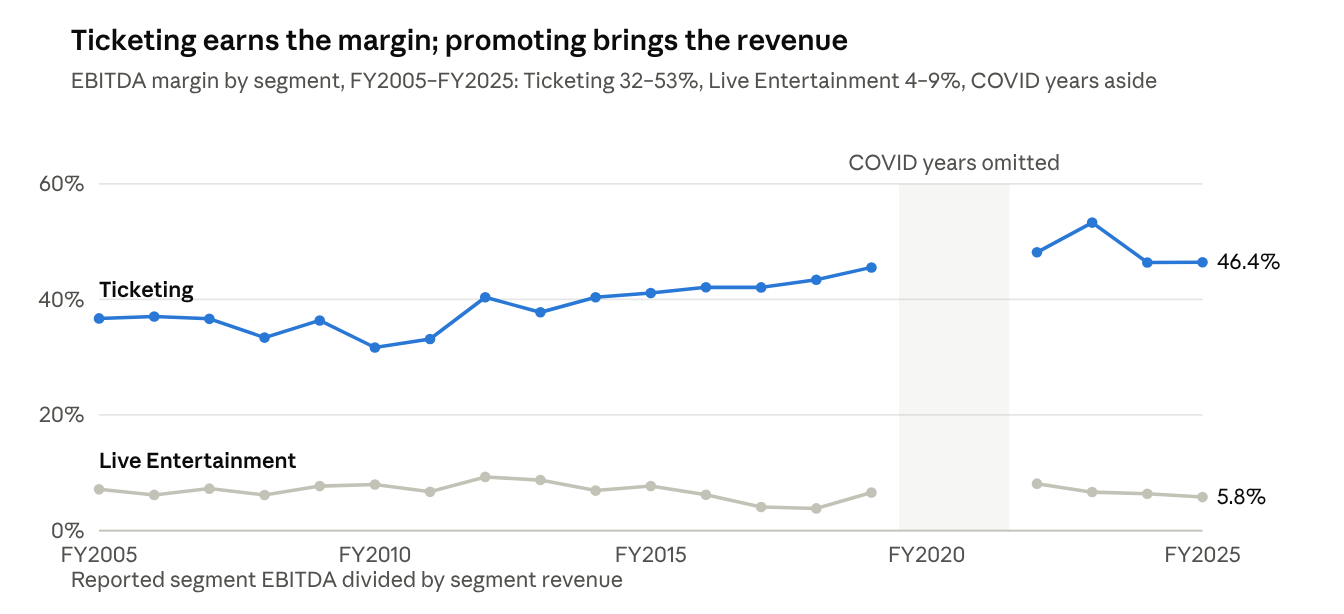
CTS Eventim annual reports FY2005–FY2025, segment note (reported segment EBITDA and revenue), compiled in the Pure Value EVD model; FY2025 adjusted margins are 46.4% for Ticketing and 6.1% for Live Entertainment
We think it's very hard to disrupt, for two reasons. A seat at a show can't be replaced by a better app, and live music demand has held up through every cycle except a pandemic. The stickier reason is where the system sits. Promoters and venues build their whole workflow around a ticketing back end, and in Germany CTS owns a lot of the promoters who pick which system sells the tickets. When the federal cartel office looked in 2017, it found 60–70% of tickets sold through ticketing systems in Germany ran on CTS's.
That same review capped it at home. The regulator blocked more consolidation in Germany and made CTS leave at least 20% of a partner's volume open to rival systems on any contract longer than two years. So growth since has come from abroad. About 70% of retail tickets now sell outside Germany, helped by buying See Tickets in 2024 and a majority of France Billet.
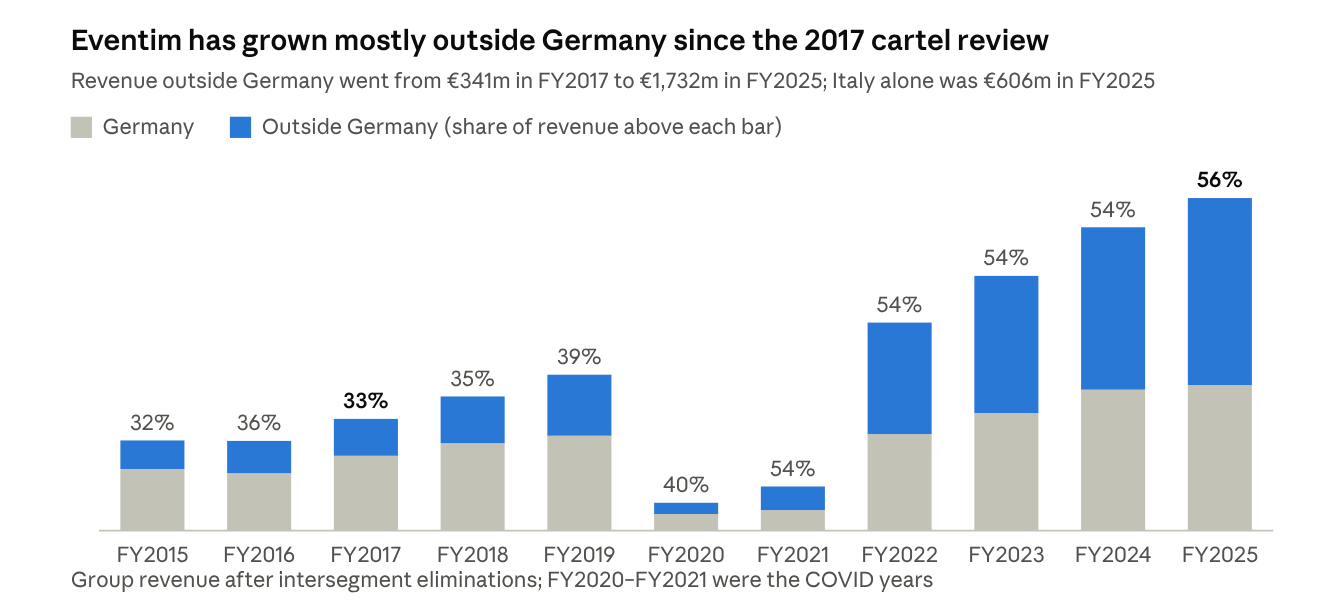
CTS Eventim annual reports FY2015–FY2025: revenue by country and group revenue after intersegment eliminations, via Fiscal.ai and the Pure Value EVD model
The volume it bought comes with lower fees. Revenue per retail ticket fell 8.1% in FY2025 once See Tickets and France Billet were in the numbers, and the Ticketing margin dropped to 36.4% in the first half of 2026 from 40.1%. Management put the drop down to the integrations and a cost program, along with Stage Entertainment moving from a ticketing partner to a retail partnership. The group still grew. First-half revenue was up 16.9% to €1,513m and adjusted EBITDA up 12.4% to €225m, and full-year guidance is for results at or slightly above last year.
The €1.6bn of cash and securities on the balance sheet at the end of 2025 overstates what shareholders have. About €1.05bn of it was ticket money owed to promoters for shows that hadn't happened yet. On CTS's own net cash definition, after that and other liabilities, it was about €200m. In a strong year the float makes free cash flow look bigger than what shareholders actually get. In a year like 2020 it goes the other way.
The shift into venues
The biggest change at Eventim is that it's now building and running arenas itself. For most of its history it was asset-light. It owned a handful of venues, like the LANXESS arena in Cologne, the Waldbühne in Berlin, the Eventim Apollo in London and K.B. Hallen in Copenhagen, and made most of its money on the ticket. Capex on property, plant and equipment ran €4–29m a year from FY2016 to FY2022, but in FY2025 it was €236m.
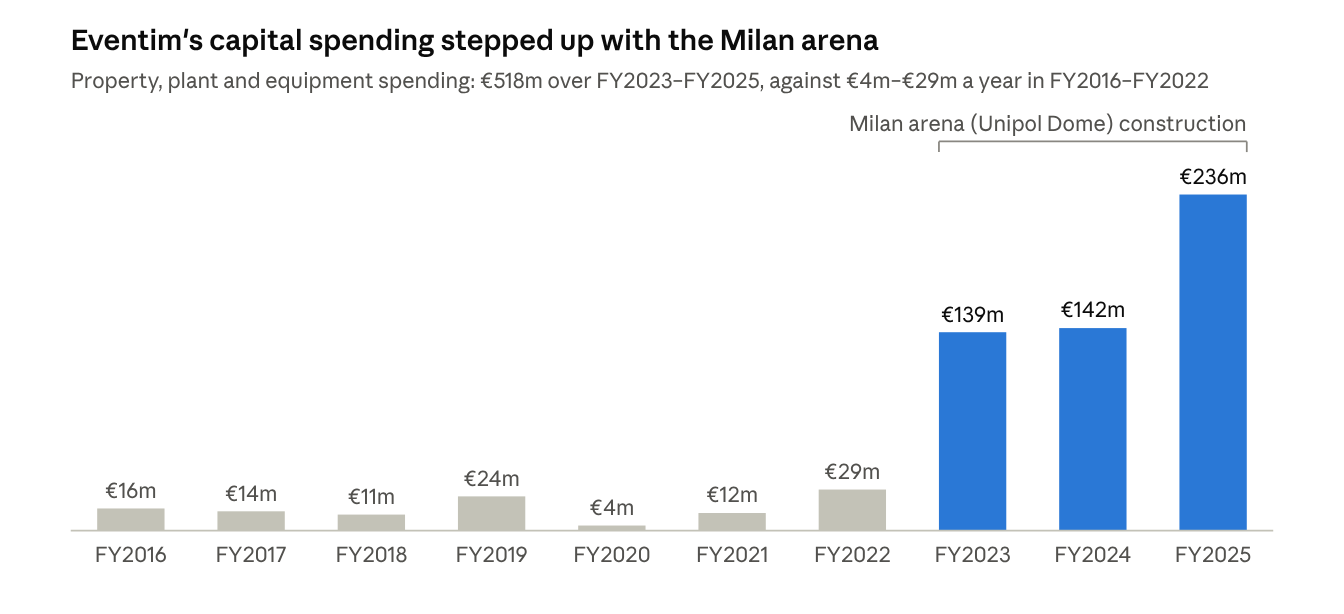
CTS Eventim annual reports FY2016–FY2025, cash flow statement (payments for property, plant and equipment), compiled in the Pure Value EVD model
Most of that is Milan. CTS developed and now runs the 16,000-seat Unipol Dome, which hosted Olympic ice hockey in February and opened for concerts on May 6, and the insurer Unipol has the naming rights through 2035. Net investment is over €400m. That's after management said in 2024 and 2025 that it would rather operate venues than own them and would look for a majority investor in Milan, a plan we liked better. Vienna is next. CTS won the job in 2024 to plan, build, finance and operate a 20,000-capacity arena due by 2030, with the city putting in up to about €153m toward construction and its holding company keeping the land and a share of the arena's revenue.
We understand why they're doing it.
- Owning the room locks in the ticketing. Every ticket sells on CTS's system, and its own promoters book their tours into it.
- The money is good. Venues keep the food, drink, hospitality and sponsorship revenue a ticketer never sees, and management says they made about 40% of Live Entertainment's adjusted EBITDA in FY2025 at a margin near 46%, plus €29m on €70m of revenue in the first half of 2026.
- Live Nation is making the same bet, only bigger. It has more than 25 large venues due to open by the end of 2027, and it bought Milan's competing Unipol Forum two days before the Dome opened.
The cost is a much more capital-intensive company. A ticketing platform that used to fund growth out of customer float is now running a construction program, and in FY2025 free cash flow covered well under half the dividends paid. We'd rather it hadn't made that trade. The Capital Markets Day is being held inside the Unipol Dome, so it's the obvious place for management to say what return the arenas are supposed to earn and how Milan gets refinanced; a sale-and-leaseback has been discussed. We'd also like to know whether more cities are coming.
People
The founder is the best thing about Eventim.
Klaus-Peter Schulenberg built Eventim and still runs it as CEO. His foundation, KPS Stiftung, owns about 39.5% after buying roughly €31m of stock this year, in four tranches between March and September at €49.50 to €54.37 a share. The supervisory board's chair and vice-chair bought in the spring too. Executive Board pay was €9.4m across four people in FY2025, 72% of it fixed, and Schulenberg is paid mainly as an owner, through the dividend.
He has control without a majority. Eventim is a KGaA, a German partnership limited by shares, and it's managed by a general partner, EVENTIM Management AG. The foundation owns that outright, and it stays in charge as long as the foundation holds more than 10% of the shares.
That works while Schulenberg is in the chair. He's 75, and the annual report doesn't say anything about succession. Given his age, and the fact that we looked into Eventim because of its owner-operator, it's hard to underwrite that when they may no longer operate it or own a controlling interest in the not-too-distant future. The CFO seat has experienced turmoil, changing hands four times since 2020. The latest CFO came from Lufthansa Technik in January and left with immediate effect on September 30, no reason given.
Price
On our cash-flow work, Eventim is fairly valued. It only looks cheap against its own historical multiples, and we trust the cash flows more.
At €63.80 the shares are down about 19% this year. Our base case, built on conservative owner earnings, implies about 7% downside from here. There's no margin of safety in that, and the base case already assumes the Ticketing margin recovers from this year's dip.
The bull case relies on the multiple. The shares trade at about 9.6 times trailing adjusted EBITDA, against a ten-year median near 14 times and more than 20 times for Live Nation, and a return to the old multiple would make the returns from here very good. We're not willing to pay for that. Venue spending and lower-fee international volume have diluted the margins, and until the numbers say otherwise we think 9 times is about right.
Eventim would need to show operating leverage to help close that gap. From 2019 to 2025 Live Nation grew profit faster than revenue, and Eventim didn't. That's what the November plan has to prove. The foundation was buying at €49–54 this year, which tells us where the biggest owner sees value.
EssilorLuxottica (EPA: EL)
EssilorLuxottica is the highest-quality business here. At its core it's a vision-care company that grows mid-single digits in almost any economy. On top of that you get eyewear, medtech, and AI glasses. Then there's the family holding company, whose heirs can't agree or get along when it comes to business.
How the stock got here
The shares closed at a record €320.70 on November 12, 2025, and were down to €139 by September 18, 2026. Three things drove it:
- Guidance went, and they dropped the 2026 margin target they had repeated for years and swapped it for a five-year outlook of "solid" revenue growth, with profit growing broadly in line and no numbers attached.
- AI glasses were expected to slow. After a huge 2025, growth was forecast to cool, and some analysts cut their numbers.
- Luxury de-rated. European luxury and consumer names sold off across the board, and EL went with them.
The business held up through all of it with constant-currency revenue growth at 10.8% in the first quarter and 8.7% in the second. The third quarter, out October 20, came in at €7,486m, up 7.2% against a year-ago quarter that grew 11.7%. The stock jumped about 15% the next day and closed at €189.10 on November 4.
Product
Nobody else covers as much of the eyewear chain. EssilorLuxottica makes prescription lenses (Essilor, Transitions) and the Satisloh machines labs use to finish them. It makes frames under brands it owns, like Ray-Ban and Oakley, and under licenses such as Prada and Chanel. Then it sells them through about 19,700 stores, Sunglass Hut and LensCrafters among them. In the US it also runs EyeMed, a vision benefits plan that covers 85 million people and pays for a lot of those purchases. Most competitors are in one or two of those steps.
The frames business really comes down to Ray-Ban and Oakley, which it owns outright. Ray-Ban was about 15% of FY2025 sales and Oakley more than 5%, and both grew double digits in analog frames in the third quarter. The luxury licenses are rented. Fashion houses have been pulling eyewear in-house, and Ralph Lauren's license ends in March 2027, so we don't give the licenses much credit.
Medtech: myopia and Nuance
The other growth engine, next to AI glasses, is medical. Lenses are technical products prescribed by optometrists, and optometrists rarely switch suppliers. EssilorLuxottica is pushing those lenses from correcting vision into treating it.
Myopia is the clearest example. Nearsightedness in kids has been rising for decades, and in September the American Medical Association backed formally classifying it as a disease. Stellest is a lens covered in tiny lenslets that slow how fast a child's eye elongates. In September 2025 it became the first and only spectacle lens the FDA has authorized to slow myopia progression. The US trial behind it, published in JAMA Ophthalmology in August, showed progression 71% slower than with standard lenses over two years. Management says Stellest got into about 12,000 US doors in its first year and that the US is already its second-biggest market after China. The myopia portfolio grew 24% in the third quarter and over the first nine months. We like this business a lot, because kids get refit every time their prescription changes, which makes it a recurring purchase a doctor prescribes.
Nuance Audio puts an FDA-cleared, over-the-counter hearing aid for perceived mild to moderate hearing loss into the arms of normal-looking glasses. It launched in the US in April 2025. The second generation, Nuance Audio Plus, came out in September 2026 starting at $829, with longer battery life and phone calls. The company says buyers across its 14 markets are five years younger on average than typical hearing-aid customers, so it's reaching people who'd otherwise put off treatment. Distribution is the advantage, since the glasses are fitted in optical stores that already see these customers.
There are also the clinical assets. EssilorLuxottica bought Heidelberg Engineering, which makes retinal imaging equipment, in 2024 and Optegra, a chain of more than 70 eye hospitals, in 2025. There have been smaller deals too, in areas like dry-eye devices and AI that reads eye scans. Management calls the goal an AI-driven eye-health platform covering clinical care and surgery. S&P did cite the shift toward eyecare and medtech when it upgraded the company to A+ on October 23.
AI glasses and the ecosystem
Ray-Ban and Oakley Meta turned smart glasses into a real category. EssilorLuxottica sold more than 7 million AI glasses in 2025, against about 2 million in total before that. Sentiment has changed in public perception and policy, with consumers worried about privacy and user intent.
The third-quarter release broke out wearables revenue for the first time. Wearables, which include AI glasses and the Nuance hearing glasses, did €486m in the quarter, up 20% at constant currency, and €1,261m over nine months. Everything else, which the company calls Eyecare & Medtech, grew 6.5% to €7,000m, its third straight quarter of acceleration. The breakout shows the core business carried this year. The fourth quarter looks tough for wearables. They did €1,091m in the fourth quarter of 2025, more than double this year's third quarter, and in the third quarter they already fell year on year in Europe and grew only high single digits in North America.
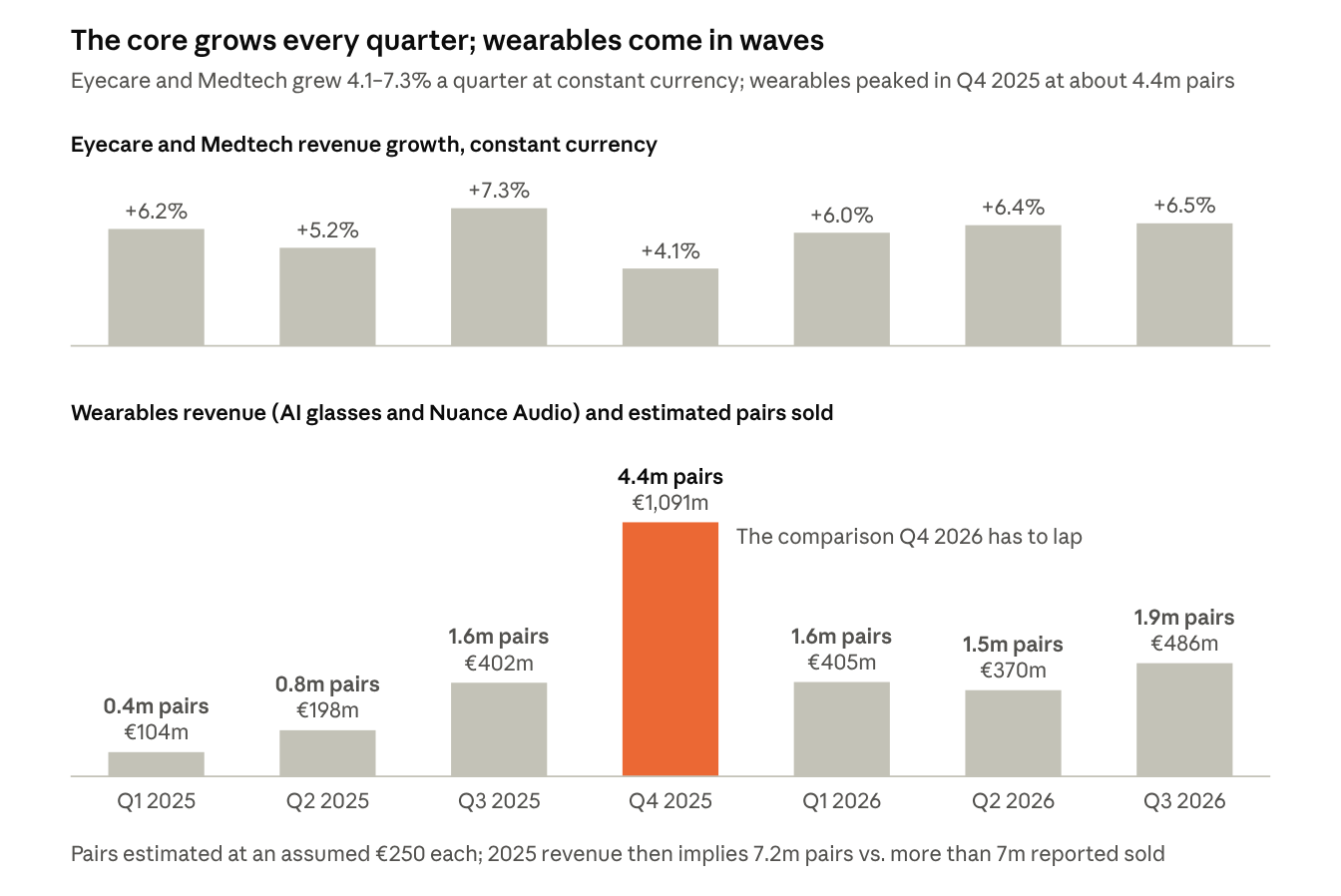
EssilorLuxottica Q3 2026 revenue release (October 20, 2026), revenue by category Q1 2025–Q3 2026; growth at constant exchange rates
At Meta Connect in September they launched the third-generation Ray-Ban Meta at $449 and a camera-free Ray-Ban Meta Audio at $349. Those sit next to the Oakley Meta sport models and the $799 Meta Ray-Ban Display. By the end of 2026 Meta expects to offer more than 100 options across Ray-Ban, Oakley and its own Meta Glasses line. A year earlier there were four product lines: Ray-Ban Meta, the Oakley Meta HSTN and Vanguard, and the Meta Ray-Ban Display. The Ray-Ban Meta Gen 2 at the core of that range came in three frame shapes and 27 frame, color and lens combinations. Meta is also adding markets like Hong Kong. EssilorLuxottica designs and makes the frames and supplies the prescription and photochromic lenses. It also sells the glasses in its own stores, and Meta reportedly owns about 3% of the company. Optics is the next step. EssilorLuxottica is working with Applied Materials on lens-based displays for AR glasses, where the screen has to be built into a lens that might also carry a prescription.
We think the margin fears were overdone. On the third-quarter call management said AI-glasses gross margins and pricing are both going up. About a third of units now ship with prescription lenses, and Transitions lenses are in about 60% of the AI glasses sold through its own stores. Meta can't supply either of those. The adjusted gross margin dropped to 60.9% in FY2025 as wearables grew and was back at 63.5% in the first half of 2026.
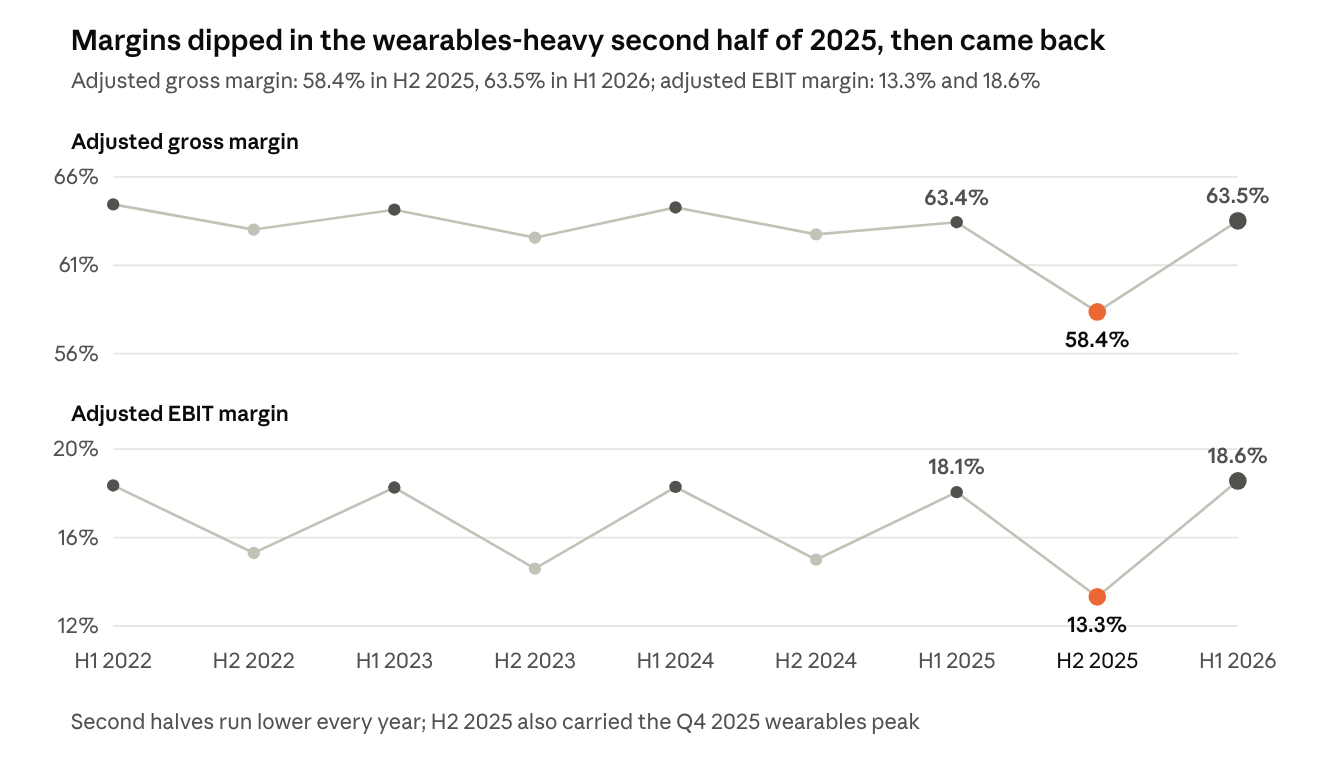
EssilorLuxottica half-year results, H1 2022–H1 2026: adjusted revenue, adjusted gross profit and adjusted EBIT, via Fiscal.ai
The risk we worry about is Google and Apple enticing users back into their ecosystems when their glasses eventually drop. If the tech platform owns the customer, the frame maker can end up as a contract manufacturer. EssilorLuxottica is tied to Meta. Google has partnered with Warby Parker and Gentle Monster, and Meta now sells its own Meta Glasses from $299 with no fashion label on them. Apple hasn't picked anyone yet. Privacy is a newer problem. In October, Norway's Consumer Council asked optician chains to stop selling the Meta glasses.
People
Leonardo Del Vecchio founded Luxottica and put together the 2018 merger with Essilor. Since he died in 2022, Francesco Milleri, his long-time right hand, has run the company as chairman and CEO, with Paul du Saillant as deputy CEO.
The problem is the largest shareholder. Delfin, the family holding company, owns 32.4% of EssilorLuxottica plus big stakes in Italian banks and Generali. Del Vecchio left it to eight heirs in equal 12.5% pieces, under bylaws that need supermajorities for key decisions. Four years in, they still haven't agreed on how to run it. Milleri chairs Delfin too.
It's now spilling into the operating company. Leonardo Maria Del Vecchio, one of the heirs, was trying to buy out two siblings. When that stalled, he quit in late August as chairman of Ray-Ban and as chief strategy officer, calling management remote and impersonal on the way out. The board publicly backed Milleri on September 9. Then on October 20, Czech industrialist Michal Strnad sent a letter offering about €30bn for Delfin and said he'd take a 62.5% stake. Italian press put the offer at roughly 30% below net asset value. Leonardo Maria says he's against a foreign buyer, and reports this week talk about competing financing efforts and more fighting among the heirs.
Capital allocation is acquisitive. There have been 67 announced deals since the 2018 merger and plenty of smaller ones. The share count has crept up about 1% a year since 2019 from scrip dividends and employee plans, net of buybacks. Return on invested capital has sat around 4–5%, weighed down by about €41bn of goodwill and acquired intangibles from the merger and GrandVision.
Price
EssilorLuxottica was interesting near its lows. At €189.10 there's not enough margin of safety for us.
Our DCF base case implies about 24% downside from here. Early on we assumed AI glasses would drag hard on gross margin. The first-half recovery partly answered that, and we've already eased the assumption. On exit multiples, the annual return we saw from the mid-October price has roughly halved after the rally. The stock is still 41% off its peak, but it's also up 36% since September.
Where they sit
Each one is strongest on a different one of the 3 Ps, and none of them clears all three today.
| Company | Product | People | Price | Why we passed |
|---|---|---|---|---|
| Pop Mart | Under test: franchise or fad | Strongest: a candid founder with 45% and a net-cash balance sheet | Hard to value until demand settles | The margin of safety was never large enough to account for business volatility. |
| CTS Eventim | Strong: a high-margin ticket rail with a 20-year record | Aligned owner, but CFO churn and no succession plan | Fair on cash flow, cheap only against history | A fair price leaves no margin of safety while the finance seat is open and the 2030 plan is unpublished. |
| EssilorLuxottica | Strongest: the core carried 2026 without help from AI glasses | Capable management; the anchor shareholder is now the risk | Fully valued after the rebound | The rebound closed the discount that drew us in, and the fight over Delfin adds a risk the price ignores. |
We passed on Pop Mart because we can't size the product. Wang owns 45% and has been straight with investors about the slowdown, and he's backing that with a net-cash balance sheet and a buyback. But revenue halved in the third quarter, and our base case is about 5% below the share price. A low multiple on peak earnings doesn't give us a margin of safety. We need to see the holiday quarter and the March results before we put a number on normal demand.
Eventim is the closest. We passed because the price is fair for the business and a deeper discount would be needed to warrant the unplanned succession. Our base case already has the Ticketing margin recovering, and the cheap multiple only matters if Eventim shows operating leverage it hasn't shown since 2019. The CFO job is being covered on an interim basis, and the founder is 75 with no published succession plan.
EssilorLuxottica is the best business of the three, and the price moved before we did. A 57% drop in a company whose core kept growing is what got our attention, and the third quarter confirmed the core. The market noticed too. The shares are up 36% from the September low and sit above our base case, and the return from our multiples work has roughly halved. Meanwhile the patient family owner that made this easy to hold is now in an open fight over Delfin with no end in sight. We'd look again after another sell-off, or once the ownership and AI glasses demand questions are settled.
Disclosures
Pure Value Capital and its affiliated clients have no position in Pop Mart, CTS Eventim or EssilorLuxottica. Pure Value Capital and its affiliated clients have positions in META and DIS, which are discussed in the Pop Mart and EssilorLuxottica sections. This article reports our views as of November 4, 2026. We may buy or sell securities mentioned in this article at any time. We have no business relationship with any company whose stock is mentioned in this article. Our views are subject to change at any time, as are our portfolio and its positions. Past performance is no guarantee of future results. No recommendation or advice is being given as to whether any investment is suitable for a particular investor.
Sources
Share prices are closes on Xetra (EVD) and Euronext Paris (EL) via Fiscal.ai, as of November 4, 2026. Pop Mart's November 4 close (HK$137.10) is from the Hong Kong Stock Exchange quote page; earlier Pop Mart prices are from the press coverage cited below.
Pop Mart
- Business update for the third quarter of 2026 (HKEX, October 27, 2026)
- Interim results announcement, six months ended June 30, 2026 (HKEX, August 20, 2026)
- Inside Retail Asia on the third quarter and management's outlook (October 30, 2026)
- Bloomberg on the 2026 target miss and SCMP on the buyback plan (August 20, 2026)
- Duan Yongping's purchase and stake (HKEX disclosure of interests, May 2026) and 36Kr on his holding
- Wang Ning's CCTV interview on Disney, translated (July 2025) and his "China's Disney" to "world's Pop Mart" remarks (July 24, 2025)
- Reuters interview with co-COO Si De on the Disney playbook (September 2025)
- Pop Mart and Sony Pictures Labubu film announcement (March 19, 2026)
- Business update for the third quarter of 2025 (HKEX, October 21, 2025), the base for the comparisons with 2024
CTS Eventim
- CTS Eventim financial reports: Annual Report 2025 and H1 2026 report (segment results, balance sheet, cash flow, shareholdings)
- CTS Eventim H1 2026 earnings call (August 20, 2026)
- Music Business Worldwide on FY2025 results
- EQS director's dealings notices for KPS Stiftung and Supervisory Board purchases, March–September 2026; EQS ad hoc release on the CFO departure, September 30, 2026
- Bundeskartellamt decisions on CTS Eventim, November and December 2017
- Unipol Dome opening release (EQS, May 7, 2026) and Unipol naming-rights agreement (January 23, 2026)
- Wien Holding Arena award (EQS, November 14, 2024)
EssilorLuxottica
- Q3 2026 revenue release (October 20, 2026) and third-quarter conference call
- Q2/H1 2026 results release and 2025 Universal Registration Document
- S&P upgrade to A+ (October 23, 2026)
- Euronews on Leonardo Maria Del Vecchio's resignation (August 25, 2026)
- Bloomberg via The Edge on the Strnad offer for Delfin and Teleborsa on terms and NAV discount (October 30, 2026)
- Stellest 24-month US trial results in JAMA Ophthalmology (August 2026) and AMA support for classifying myopia as a disease (September 2, 2026)
- Nuance Audio Plus launch and US pricing and buyer age across 14 markets (September 2026)
- Meta Connect 2026 lineup (September 23, 2026)
- Meta's "more than 100 glasses options" by end-2026 (Meta, September 23, 2026) and Ray-Ban Meta (Gen 2) launch: three frames and 27 frame, color and lens combinations (TechRadar, September 2025)