Idea #2
Why We Sold Airbnb
October 2, 2026 · Pure Value Ideas
We’ll always tell you when we change our mind on a name. We exited Airbnb a few weeks ago after holding it for roughly three years, and the business was in better shape when we sold it than when we bought it. Revenue went from $9.9 billion in 2023 to $13.2 billion over the twelve months through June 2026, and free cash flow (FCF) went from $3.8 billion to $4.8 billion. Nights booked rose to 560 million from 448 million.
For about twenty years travel platforms have been paid mainly for being where a trip starts and controlling what the traveler sees.
AI agents move that starting point. An agent shopping on your behalf books wherever the numbers work out best, which is a real problem for a company whose biggest advantage is that people come to it directly.
Two things pushed us out.
- Agents make it easier for guests to find the cheapest listing for a property and easier for hosts to spin up a direct listing. Meta’s Muse is the one we worry about most, and Meta already sells paid tiers and expects over time to take a small fee on transactions. Airbnb’s reported pilot of 6% and 10% host fees when hosts bring their own guests tells us management sees the same risk.
- The valuation got ahead of delivery. We bought because Airbnb cleared our 3 Ps: a founder-led team (Chesky models the vision on Amazon going from books to everything), the strongest brand in travel, and FCF margins above 35% that funded about $10 billion of buybacks while we owned it, at prices we thought were depressed, cutting the share count roughly 8%. The trigger was how slowly new products were launching. Chesky was describing an AI concierge on the May 2023 call; AI search only reached US guests on September 30, and the agent is set for 2027. A loyalty or membership program has come up on most calls since May 2025 and still hasn’t launched; this month Chesky said the major announcements come next year. Over the same stretch the multiple went from about 17x trailing FCF when we bought to about 21x when we sold.
What a travel platform actually sells
Hosts and hotels pay online travel companies for demand. On Airbnb the service fee is the host’s whole bill; listing is free, and the fee comes out of the host’s payout. Across all bookings that fee works out to the take rate, the share of each booking dollar the platform keeps.
Airbnb doesn’t sell hosts anything beyond that yet. Chesky told a Goldman Sachs conference on September 8 that sponsored listings, where hosts pay for better placement, are a fairly direct path to about $1 billion of high-margin revenue, and Vrbo rolled out its version globally on September 1, with hosts bidding for top placement and paying per booked night. Instinct, an AI agent startup that just raised $1 billion from backers including Sequoia, Benchmark and Coatue, said paid placement carries no weight in its choices and that it defaults to booking direct with hotels and airlines, according to Skift.
The fee only holds up as long as travelers keep starting at the platform. Booking Holdings and Expedia now get most of their consumer bookings direct as well, but they pay far more to keep it that way, mostly by buying traffic from Google and paying affiliates.
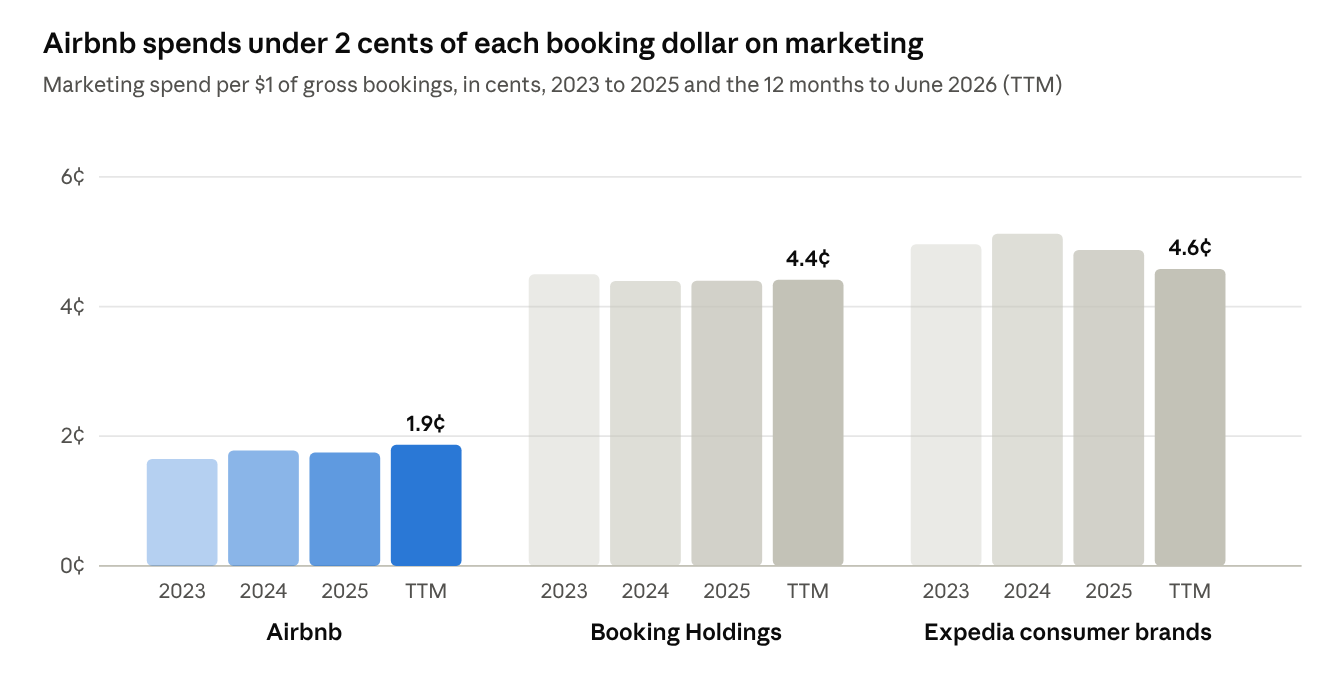
Source: Company 10-Ks FY2023 to FY2025 and Q2 2026 10-Qs; TTM is the 12 months to June 30, 2026. Airbnb: brand and performance marketing ÷ gross booking value. Booking Holdings: total marketing expenses ÷ gross bookings. Expedia: B2C direct selling and marketing ÷ B2C gross bookings.
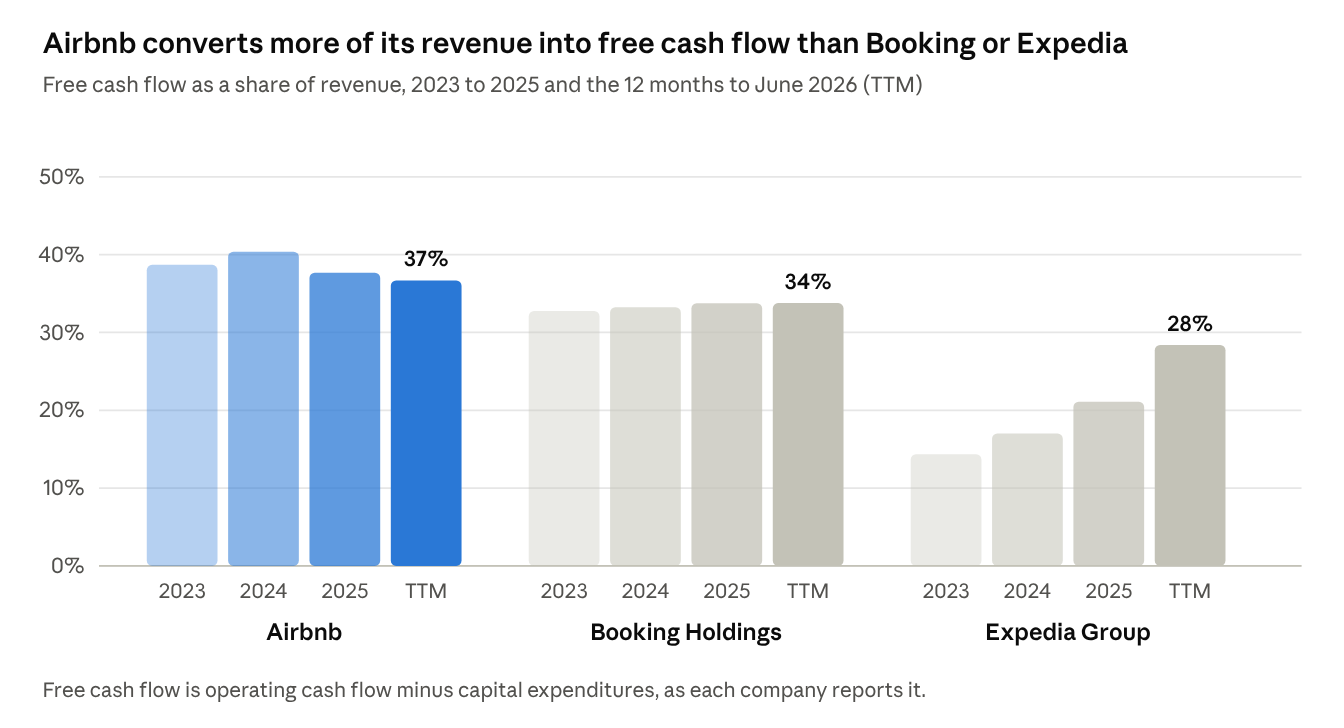
Source: Company 10-Ks FY2023 to FY2025 and Q2 2026 10-Qs and earnings releases; TTM is the 12 months to June 30, 2026.
Unpaid traffic is Airbnb’s moat. At its IPO, Airbnb said about 91% of its traffic in the first nine months of 2020 came through direct or unpaid channels, though that was a year when it had paused most paid marketing. Brian Chesky said this month it’s still nearly 90%.
Professional hosts often list the same home on Vrbo, Booking.com and their own site, so the listings alone don’t protect Airbnb. People going to Airbnb first out of habit, without anyone paying for that click, is much harder to copy.
That habit is why Airbnb has kept roughly 13 cents of every booking dollar for years while spending under 2 cents of it on brand and performance marketing, and why it earned an adjusted EBITDA margin of about 35% in 2025. We think a good chunk of the multiple assumes Airbnb keeps its 13 cents.
What agents change
There are two parts to a booking, choosing the booking and paying for it. Google has long helped people find the platforms, but the choosing and the paying both happened on the platform.
Agents take over the choosing. You tell one you want a three-bedroom near the beach for under $500 a night, and it does the searching and comes back with an answer.
The products launched or announced in recent weeks already work this way. When Google began rolling out hotel booking in AI Mode on August 27, the hotel or booking site stayed the merchant of record and kept customer service, but the traveler picks the room and pays with Google Pay without leaving Google. Expedia’s hotel integration with Meta’s Muse, announced September 24 and due in the US soon, is set up the same way: Expedia is the merchant of record and checkout happens inside Muse.
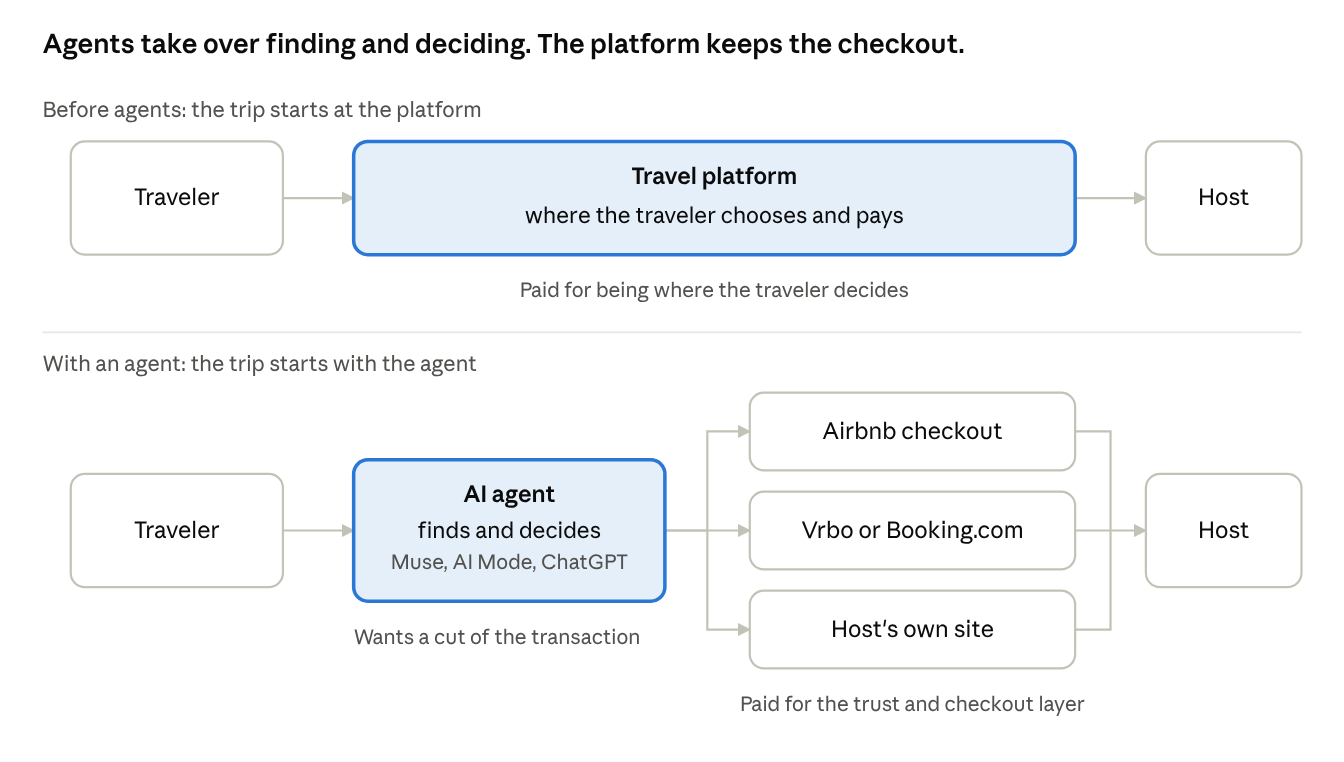
How a stay gets booked, before agents and with one.
The graphics above illustrate the issue agents have brought to the OTAs; there’s now a layer between them and the customer. The platforms still process the booking and handle insurance and customer service, so they don’t disappear, but that work only earns a utility’s margin. The premium in a take rate pays for being where the traveler makes the decision, and the agent is taking that over.
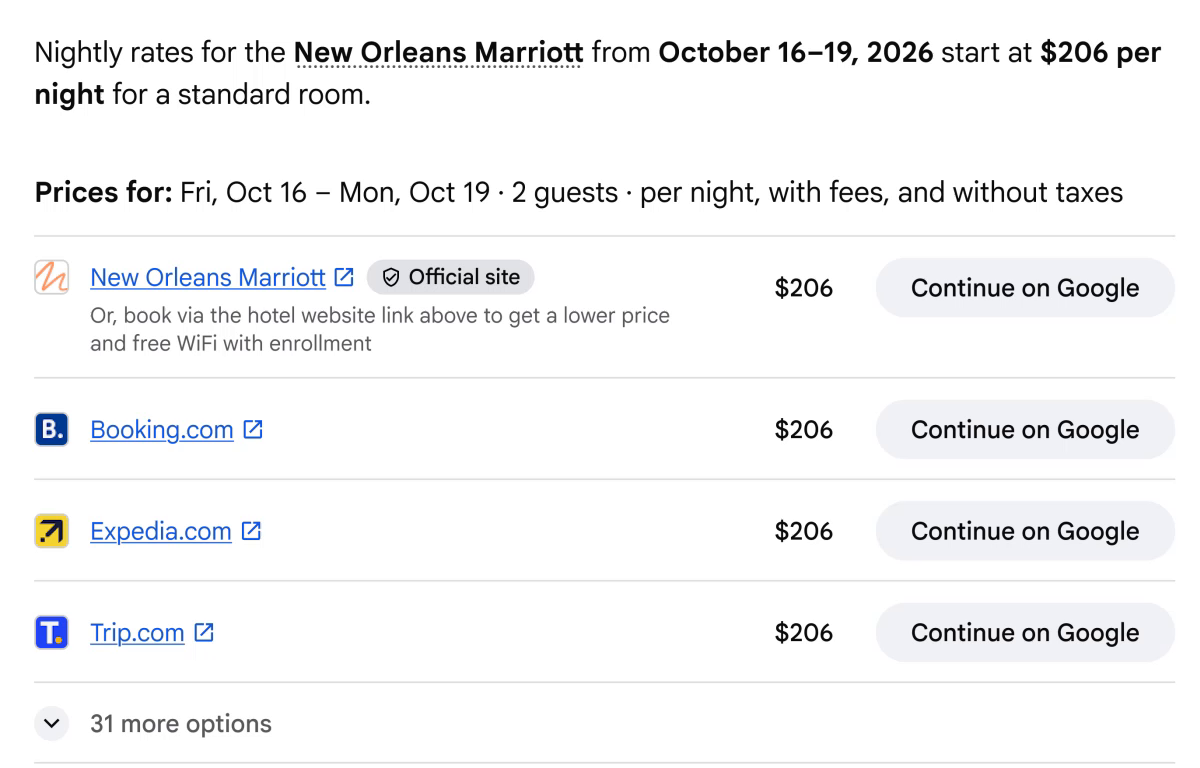
The same $206 room from the hotel and three booking sites, and every option checks out through Google. Source: Google’s AI Mode hotel booking demo (results simulated), Aug 27, 2026.
Airbnb sees it as well. Its 2024 annual report first warned that travelers might lean less on search engines and more on AI, and that Airbnb might not be able to optimize for those new channels. The 2025 report sharpened the wording to AI apps.
The volume is still small. Booking Holdings told investors in August that AI-driven referrals are a relatively small contributor, which its CFO put at under 1% of room nights, and Expedia called agent traffic small but promising. How well that traffic converts matters more.
Adobe, which tracks traffic to US travel sites, found AI-referred visits grew 119% year over year in July 2026. In October 2024 the conversion gap between visitors coming from an AI tool and everyone else was about 86%. By July 2026 it was roughly 1%, partly because everyone else converted worse, and the gap has swung month to month.
Phocuswright found this summer that more than half of US travelers have already used AI for some part of a trip, and 44% said they’d book inside an AI platform. Expedia’s April survey of US, UK and Indian travelers found only 8% comfortable booking through an AI platform.
So far AI has shifted trip planning a lot more than booking. That’s worse for Airbnb than for the others, because its edge sits in the planning stage, as the first place people go while they’re still deciding. If the deciding moves into an agent, the habit weakens well before it shows up in bookings, and the market may have repriced the stock before the take rate shows it.
Why Muse sparked our worries
Google, OpenAI and Meta are all building agents that book travel, but Meta’s Muse is the one that moved us. Part of that is the reach of its parent, the virality and velocity, and a business model aimed at the transaction and the take rate. The bigger part is that it’s designed for maximum user utility with minimal user input. Given access to personal finances, Muse can suggest ways to cut spending, and on a trip it hunts for the best price.
Meta launched Muse on September 8 as a personal agent that does work on your behalf, from sending email to booking travel. It runs in its own app and inside WhatsApp, and the company behind it reached 3.6 billion people a day in June.
Muse has been the No. 1 free app on the US App Store since September 18. App tracker Apptopia put it at about 640,000 US mobile daily users by day 12, nearly three times ChatGPT at the same point, and Sensor Tower says it passed 5 million downloads in about three weeks, against 56 days for ChatGPT. OpenAI’s answer, Dots, arrived on September 29 as always-on agents inside ChatGPT, but only on its Pro and Business Premium plans so far.
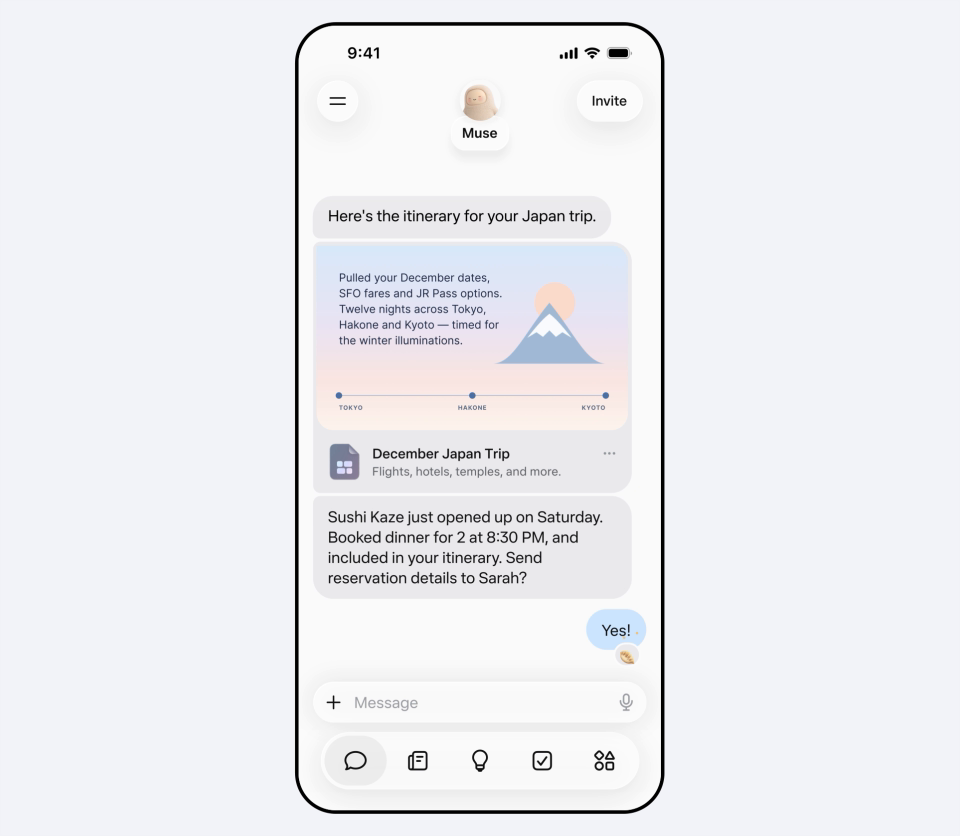
Muse planning a Japan trip in its own app: it books dinner, then asks before sending the details on. Source: Meta’s Muse launch demo, Sep 8, 2026.
Meta wants a take rate of its own. Muse is free for most of what people need, and at Connect on September 23 Mark Zuckerberg said that over time Meta would make money by taking a small fee on transactions. Travel companies have long paid Meta for ads that push people toward a booking; Booking Holdings even flagged in its latest annual report that more of its performance marketing is going to social media. With Muse, Meta aims to take a piece of the booking itself. We think the platform in the middle is the likeliest to pay for that piece.
According to Meta, Muse remembers what matters to you and keeps working after you close the app, checking back when something changes or before it sends or spends anything. A few days after launch, Meta’s chief AI officer, Alexandr Wang, challenged users to have Muse save them $1,000, and early testers report it canceling unused subscriptions and finding cheaper phone and insurance plans, with mixed results. In Skift’s launch-week test, Muse shopped for hotels by browsing Expedia and Hotels.com the way a person would, with no commercial deal in place, and kept searching when results came in over budget.
Expedia’s image for hotel booking in Muse, due in the US soon. Source: Expedia newsroom, Sep 24, 2026.
Airbnb’s approach so far has been to hold out. When OpenAI launched apps in ChatGPT in October 2025, Booking.com and Expedia were among the first partners and Airbnb stayed out. Chesky said on the November call that the integration wasn’t ready and that Airbnb didn’t want to show up as a commodity data layer. He’d turned down Google Hotel Finder for the same reason, since homes looked like commodities next to hotel rooms, and Airbnb isn’t a launch partner for Google’s AI Mode booking either. In September, Skift reported that Chesky treats AI platforms as channels that send traffic to Airbnb rather than places to book, and he committed to launching Airbnb’s own agent in 2027.
That made sense while Google and OpenAI needed good partners to make their travel products work, and for a while we agreed with it. It stops working against an agent that can open a browser on its own and is built to get its user the best deal. An agent like Muse doesn’t need Airbnb’s permission to read a listing, and it could find the same home on Vrbo or the host’s own site. It would likely send the traveler wherever the total is lowest. Airbnb could try to block agents the way Amazon blocked Muse from its store in September, but Walmart and Best Buy signed on with Muse days later, and blocking cuts off the newest source of demand.
Meta also reaches Airbnb’s hosts, and plenty of them already market their homes on Instagram. Meta said in July that more than a million businesses a week use its business agents to talk to customers or complete sales, and it pointed to Movida, one of Brazil’s largest car rental companies, whose WhatsApp agent handles the whole booking, from choosing a car to paying. On September 29 Meta added small-business tools to Muse, connected to a business’s Instagram and Facebook accounts and to apps like Stripe, so an owner can hand it goals like finding new customers. When Airbnb wanted hosts to bring their own guests at a lower fee this summer, the pitch was to share a link on social media.
| Date | What happened |
|---|---|
| Sep 30, 2026 | Airbnb’s fall update brings AI search and side-by-side comparison to US guests. No agent partnerships announced |
| Sep 29, 2026 | Booking Holdings launches Lola, an AI assistant that hands paying members its commission back as lower hotel rates |
| Sep 29, 2026 | OpenAI launches Dots, always-on agents inside ChatGPT, on its Pro and Business Premium plans |
| Sep 24, 2026 | Expedia details hotel booking in Muse: Expedia stays merchant of record, checkout happens in Muse (coming soon to the US) |
| Sep 23, 2026 | Meta Connect: Zuckerberg says Muse will eventually make money from a small fee on transactions. At Skift’s Global Forum the same day, Chesky commits to an Airbnb agent in 2027 |
| Sep 8, 2026 | Meta launches Muse in the US, with flights through Duffel |
| Aug 29-31, 2026 | Reports surface of Airbnb’s direct booking link pilot at 6% or 10% host fees |
| Aug 27, 2026 | Google AI Mode hotel booking starts rolling out in the US. No Airbnb or Vrbo among partners |
| Mar 2026 | OpenAI moves Instant Checkout out of core ChatGPT to focus on discovery |
| Nov 6, 2025 | Chesky explains why Airbnb stayed out of ChatGPT apps |
| Oct 6, 2025 | Apps in ChatGPT launch with Booking.com and Expedia as early partners |
| May 12, 2025 | FTC rule requiring all-in prices for short-term lodging takes effect |
The take-rate war
Competition over the take rate has already started, and some of the first moves were Airbnb’s.
For most of its life Airbnb split its fee: hosts paid about 3% and guests paid a separate service fee at checkout, most recently 14.1% to 16.5% of the subtotal. In late 2025 it started moving hosts to a single 15.5% fee paid entirely by the host. Hosts on property management software went first, and most of the rest had until September 15, 2026 to adjust their prices before switching (October 13 for hosts living in the European Economic Area or Switzerland).
Airbnb set the 15.5% at its average fee and expected a modest lift to its take rate, which held at 13.2% in the second quarter. The bigger change is who sees the fee. Under the old system the guest saw Airbnb’s cut as its own line; under the new one it’s folded into the host’s price. Management has said many hosts didn’t raise their rates to cover it, so guests paid a bit less, and CFO Ellie Mertz said in August that the single fee puts downward pressure on pricing.