Idea #1

The Art of Holding
October 2, 2026 · Pure Value Ideas
We bought Meta between October 2022 and January 2023, at the end of its metaverse era, at an average of $120 a share. Facebook had renamed itself a year earlier around a virtual world few people were using, and by November the stock was down three-quarters from its 2021 high. On September 29 Meta closed at $738.79, a little over six times our cost.
Since we bought, Meta has twice lost about a third of its value and has fallen about 8% to 11% in a single day six times. It was reported to be weighing a share sale that could raise tens of billions of dollars, and its long-term debt went from under $10 billion to $84 billion. Each time there was a good case for selling. Holding is the hardest part of investing, and Meta has tested us.
Why we bought in the metaverse era
Our December 2022 letter opened with: "Metaverse, Mark Zuckerberg, Meta, 3 things with huge controversies." The case against Meta was long, and most of it was fair:
- Apple's App Tracking Transparency had broken the ad targeting Meta relied on. In February 2022 Meta put the hit at about $10 billion of revenue that year.
- Reels was winning time back from TikTok but monetized at a lower rate than Feed and Stories, so every hour that moved to Reels cost Meta money.
- Reality Labs lost $13.7 billion in 2022, and management said the losses would grow significantly in 2023.
- Capex was guided up from $32 billion to $34–39 billion for 2023, with Meta saying new AI capacity drove substantially all of the increase.
- Revenue fell 1% in 2022, Meta's first annual decline as a public company.
The Q3 2022 report on October 26 took 25% off the stock the next day, to $97.94. Two days earlier Altimeter Capital had published an open letter asking Meta to cut headcount costs by 20%, trim capex and cap metaverse spending at $5 billion a year. The stock closed as low as $88.91 on November 3, and Meta finished 2022 down 64%.
We thought the market was pricing Meta on its worst year. Instagram is where people's friends are, while TikTok is mostly strangers performing for a mass audience, and with a better algorithm Reels could offer both. It did. The capex everyone hated was buying GPUs to rank Feed, Reels and ads, which is how Meta would rebuild its targeting after Apple's changes. Then on November 9, 2022, a founder the market had written off as unable to run a lean company cut more than 11,000 jobs, 13% of the staff.
The 2022 bear case came down to capex the market didn't trust and a founder's bet it didn't like. That's the 2026 bear case too.
What we paid
At $120 we paid about 14 times Meta's 2022 earnings, but only about 6.6 times what its core apps earned before tax.
FY2022 measure | Amount | At $120 a share |
Market value | 2.59B shares | $311B |
Enterprise value | $311B less $40.7B cash, plus $9.9B debt | $280B |
Net income (diluted EPS $8.59) | $23.2B | 14.0x diluted EPS |
Operating income | $28.9B | 9.7x EV |
Family of Apps operating income | $42.7B | 6.6x EV |
Family of Apps operating income after tax (19.5%) | $34.3B | 8.2x EV |
Free cash flow | $18.4B | 16.9x market value (5.9% yield) |
Free cash flow less stock compensation | $6.4B | 48x market value |
The gap came from two costs we didn't think would last: $13.7 billion of Reality Labs losses and $4.6 billion of restructuring for office consolidation, severance and data center write-downs. Without Reality Labs, the apps earned $42.7 billion of operating profit, even after carrying $4.1 billion of restructuring charges. We were paying about 6.6 times that for the whole company, which after tax worked out to roughly a 12% earnings yield on Facebook, Instagram, WhatsApp and Messenger, with the metaverse thrown in free.
On FCF minus SBC (our preferred metric), Meta looked expensive at 48 times, because $32 billion of capex and the Reality Labs losses were eating the cash. We thought the capex was worth it to fight against TikTok's algorithm. Our December 2022 work valued the apps alone at $450–550 billion, against a market value near $300 billion, and treated the metaverse as an option we didn't have to pay for.
What we were buying
Underneath the headlines we were buying a matching engine with more reach than almost any company in the world: 2.96 billion people a day on one side, more than 200 million businesses a month on the other, and few other places those businesses could reach the same people.
In 2022 that engine was being rebuilt, and it was costing money. Feeds were moving from friends' posts to AI recommendations from accounts people didn't follow, which let Reels compete with TikTok even though Reels monetized at a lower rate than Feed, and targeting was being rebuilt after Apple's changes. Meta served 18% more ads that year at 16% lower prices.
We bet the rebuild would work and both costs would reverse. Recommendations that could find an audience for a creator with no followers would keep feeds full without Meta owning any of the content. Better targeting would get advertisers more from each ad, and they'd pay more for it. And businesses would reach customers more and more by message, where WhatsApp and Messenger already led.
Four years on, each bet has paid off:
When we bought | Now | |
Daily users of Meta's apps | 2.96 billion | 3.60 billion |
Reels | Monetizing below Feed and Stories | Over $50 billion annual revenue run-rate |
Automated ad campaigns (Advantage+) | Launched August 2022 | Over $75 billion annual revenue run-rate |
Business messaging | Click-to-message ads at a $10 billion run-rate | More than 1 million businesses a week using Meta's business agents |
Price per ad | Down 16% in 2022 | Up 9% in 2025 and 12% in the first half of 2026 |
What we held through
The chart below points out the many times people have decided to sell their Meta shares.
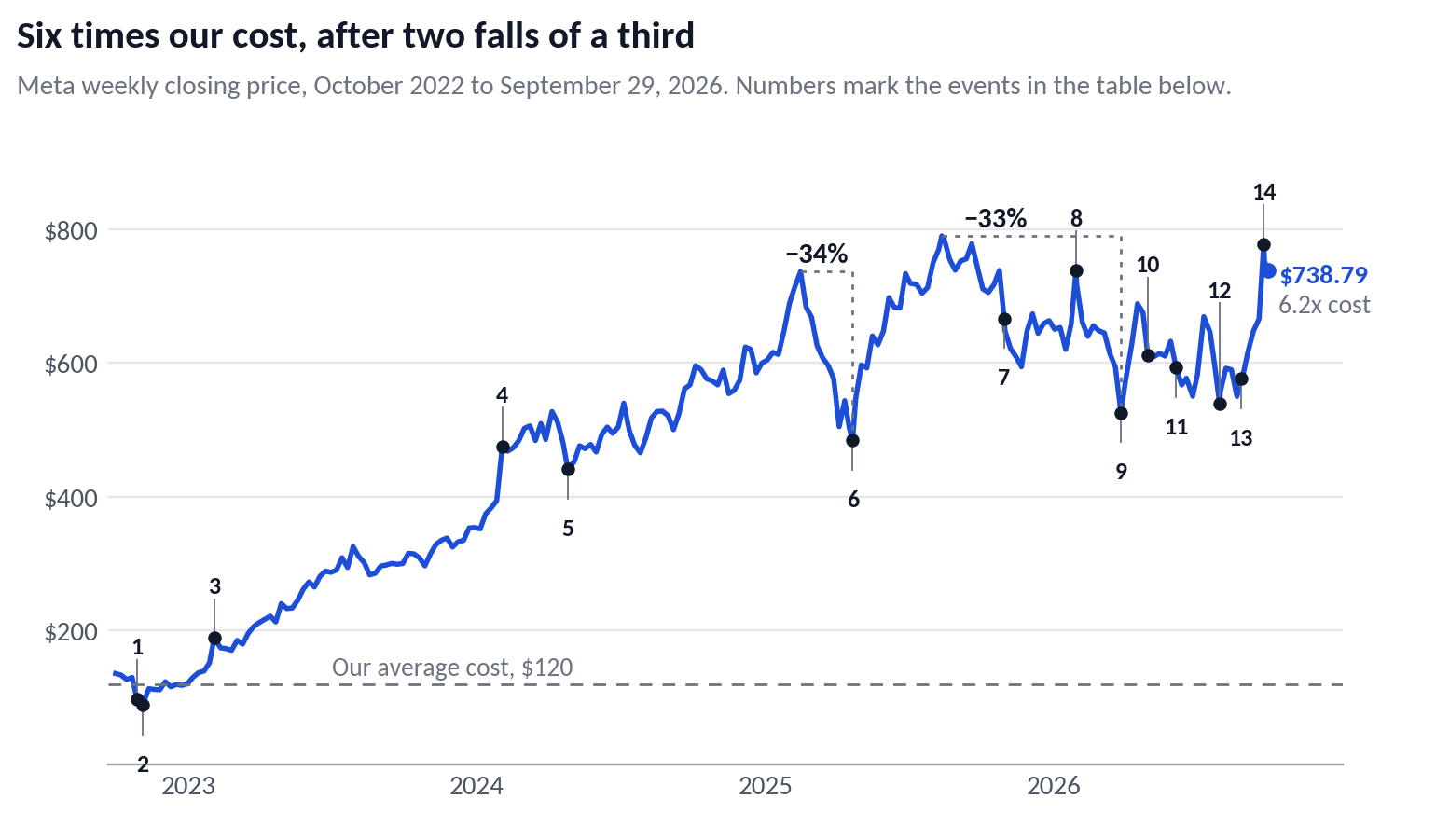
# | Date | What happened | Stock |
1 | Oct 27, 2022 | Q3 2022 report; 2023 capex guided to $34–39B | −24.6% to $97.94 |
2 | Nov 3, 2022 | 2022 closing low | $88.91 |
3 | Feb 2, 2023 | "Year of efficiency" and a $40B buyback | +23.3% |
4 | Feb 2, 2024 | First dividend and a $50B buyback | +20.3%, a then-record $196B one-day gain |
5 | Apr 25, 2024 | 2024 capex raised to $35–40B | −10.6% |
6 | Apr 21, 2025 | Tariff sell-off low | $484.66, 34% below February's close |
7 | Oct 30, 2025 | 2026 capex growth "notably larger"; $30B bond follows | −11.3% |
8 | Jan 29, 2026 | 2026 capex guided to $115–135B | +10.4% |
9 | Mar 26–27, 2026 | Youth-safety verdicts (Mar 24–25); lowest close since April 2025 | −8.0%, then $525.72 |
10 | Apr 30, 2026 | Capex raised to $125–145B; JPMorgan downgrade | −8.6% |
11 | Jun 5, 2026 | Report that Meta may sell stock to fund AI | −5.5% |
12 | Jul 30, 2026 | Q2 free cash flow falls to $784M | −8.0%, an 11th straight decline |
13 | Aug 26, 2026 | Settlement with 51 attorneys general, up to $17.1B | +1.1% |
14 | Sep 21–24, 2026 | Muse hits No. 1 on the App Store (Sep 18); Connect (Sep 23–24) | +11.3%, then a $777.59 close |
2023: not selling a triple
The first test came from the upside. On February 1, 2023, Zuckerberg called it the year of efficiency and Meta added $40 billion to its buyback, and the stock rose 23% the next day. Another 10,000 job cuts followed in March, and Meta finished 2023 up 194%, its best year on record. Selling after a triple would have been easy to defend, but our December 2023 letter said we still planned on holding for a long time, because the family of apps kept getting stronger, with Reels, WhatsApp business messaging, payments and shopping all growing.
2024: the first capex warning
2024 opened the same way. In February Meta declared its first dividend and added $50 billion to the buyback, causing the stock to add $196 billion of market cap in a day, a record at the time. Then in April it raised its 2024 capex outlook to $35–40 billion and fell 10.6%, its worst day in 18 months. That was the first look at the pattern that has defined 2026: spending goes up, the stock goes down.
2025: tariffs, the talent war and the bond market
Tariffs hit everything in the spring of 2025, and Meta fell 34% between its February 14 close of $736.67 and April 21. In June it invested in Scale AI, hired its co-founder and chief executive, Alexandr Wang, and set up Meta Superintelligence Labs, spending heavily to rebuild its AI team. To many investors it looked like the metaverse all over again. The stock hit a record $790 close in August, then fell 11% on October 30 after Meta said 2026 capex growth would be notably larger. The same day it priced a $30 billion bond, its largest ever, nine days after agreeing a $27 billion data center joint venture with Blue Owl. In December 2025 we still called Meta a core investment, for its network effects and its founder-owner.
2026: the treadmill
This year has been the hardest to sit through. Capex guidance rose from $115–135 billion in January to $130–145 billion by July. In March Meta lost youth-safety verdicts in New Mexico and Los Angeles, the stock closed at $525.72, a third below its August 2025 high, and the comparisons to Big Tobacco in the late 1990s weren't comforting. In June the Financial Times reported Meta was weighing a share sale to fund its AI buildout, which Meta called pure speculation. In July second-quarter free cash flow came in at $784 million, and the stock fell for consecutive days.
All the while the business was speeding up. Revenue grew 33% in the first quarter, the fastest since 2021, and 28% in the second. In early June, Meta was the worst Magnificent Seven stock over the prior twelve months, right as it posted its best growth in years as its ads business outpaces Google's and is on pace to take the throne for most digital ad spend dollars received.
September: the settlement and Muse
On August 26, in the second week of the states' trial, Meta settled with 51 attorneys general for up to $17.1 billion over ten years, $12.19 billion of it guaranteed, which took the biggest legal overhang away. Meta expects to book a charge of about $10 billion for it in the third quarter. Muse launched on September 8 and hit No. 1 on the US App Store on September 18, and the stock jumped 11% the next trading day. From the settlement to the Connect high on September 24, Meta rose 35%, to $777.59, and by September 29 it was up 29% for the month. The legal risk hasn't gone away, though. On September 25 a second Santa Fe jury found that Meta had committed about 43.9 million violations of New Mexico's consumer-protection law in past statements about privacy and misinformation. The state wants the maximum $5,000 per violation, about $219 billion in theory, and a judge will set the penalty. None of that changed what we own. The business we held at $526 in March is the same one at $778.